One HTML file on one device. Seven fields, one number for "rooms to clean" across a whole building, no photos, no price. 582 of 1,243 quotes were revised within 60 days.
Site walk to priced proposal to won contract on a phone, room by room, with photos and a condition score. One write to the operations system, only when the deal is won.
How I picked the problem
For six months before the hackathon, I kept running into the same gap across RFPs, recorded customer calls and discovery with our current customers: everything that happens before a work order exists runs on Excel, email and WhatsApp. I listened to the call recordings, spoke with customers and used AI to pull the common thread out of the calls. When the hackathon came, there were hundreds of candidate problems. I ruled them out one by one, and kept the one that passed three tests.
- Customer value. Every FM provider we serve has this problem, and nobody has solved it end to end. Their own sales and CS teams told us they struggle with it.
- Business value. Every provider needs it, so it is a product we can sell across our whole base, not a one-off build.
- It repeats. Every enquiry, every site walk, every proposal. In our own data, 582 of 1,243 quotes were revised within 60 days.
"Usually it's just in their head." Ops lead, US cleaning contractor
"Now we are manually creating quotations in an Excel sheet." Ops manager, Middle East FM firm
What it does
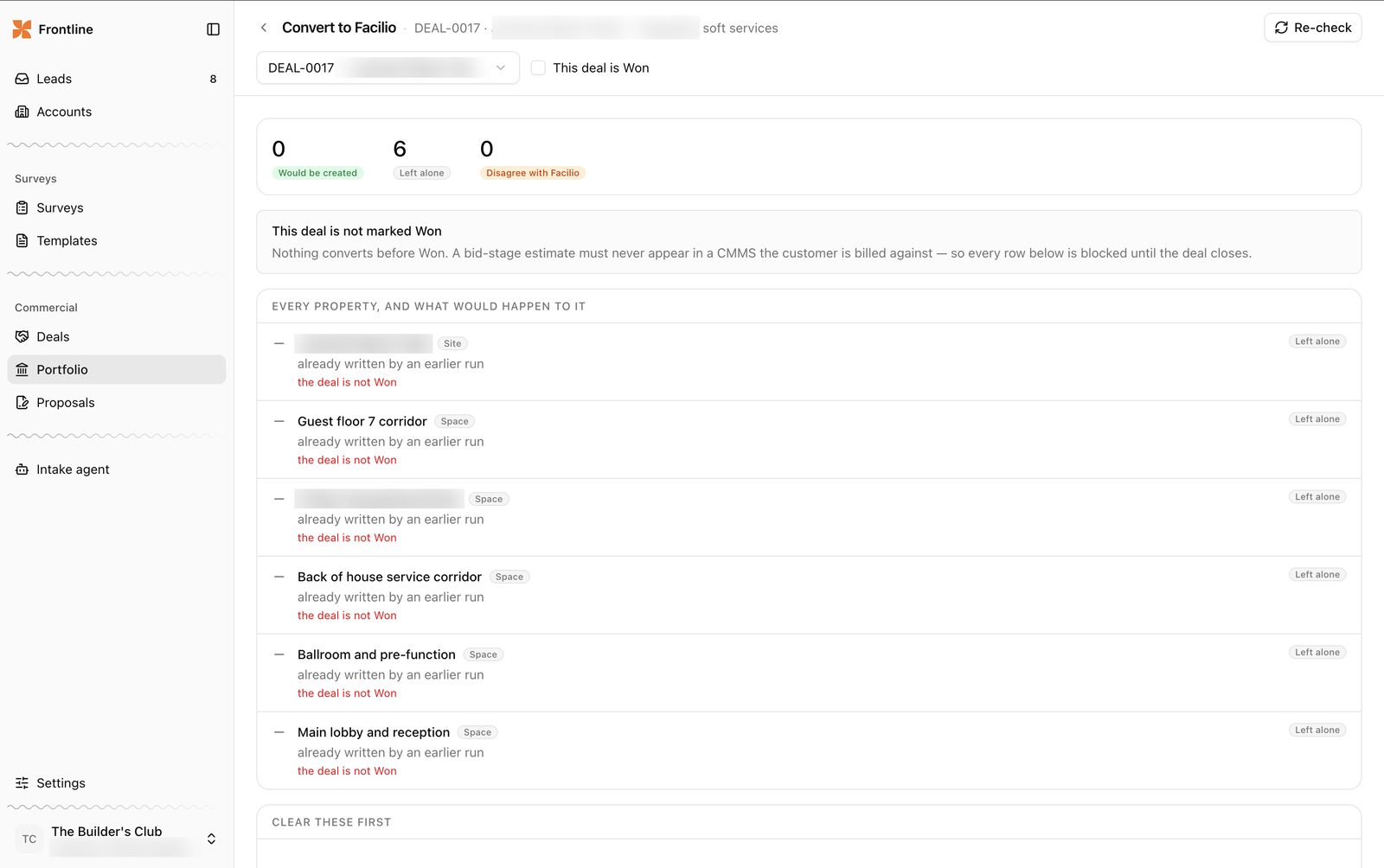
Frontline carries the enquiry through the site walk, the priced proposal and the win, then creates the site, spaces and contract in the operations system in one step. I did the discovery, then built it with two teammates in a hackathon.
The commercial chain
What no other product does
- One chain, end to end. From the site survey to a priced proposal to a live contract and work orders. Bidding tools stop at the PDF. FM platforms only start once the contract exists.
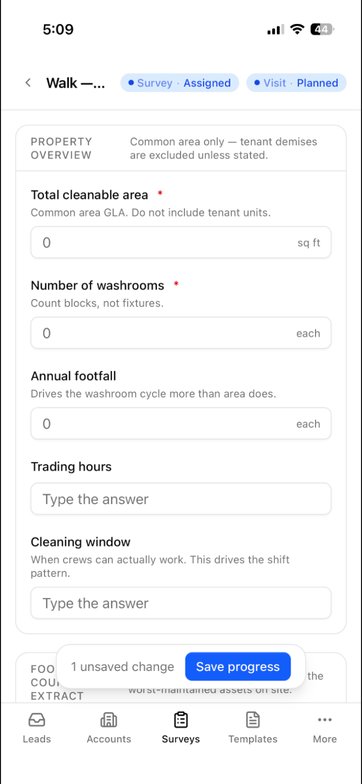
- Start from whatever you know. An RFP, scattered notes from a phone call, or nothing but an address. The same survey takes all three.
- When the RFP and the site disagree, a person decides. An RFP gives you the asset list, but not always the right one. It says 20,000 assets and the walk finds 20,100, or it says Siemens where the surveyor finds Schneider. Every value keeps where it came from, the conflict is flagged, and it is resolved before the proposal goes out.
- The walk builds the property tree. Each room the surveyor adds becomes a space under its site and building, and lands in the operations system as a real record when the deal is won.
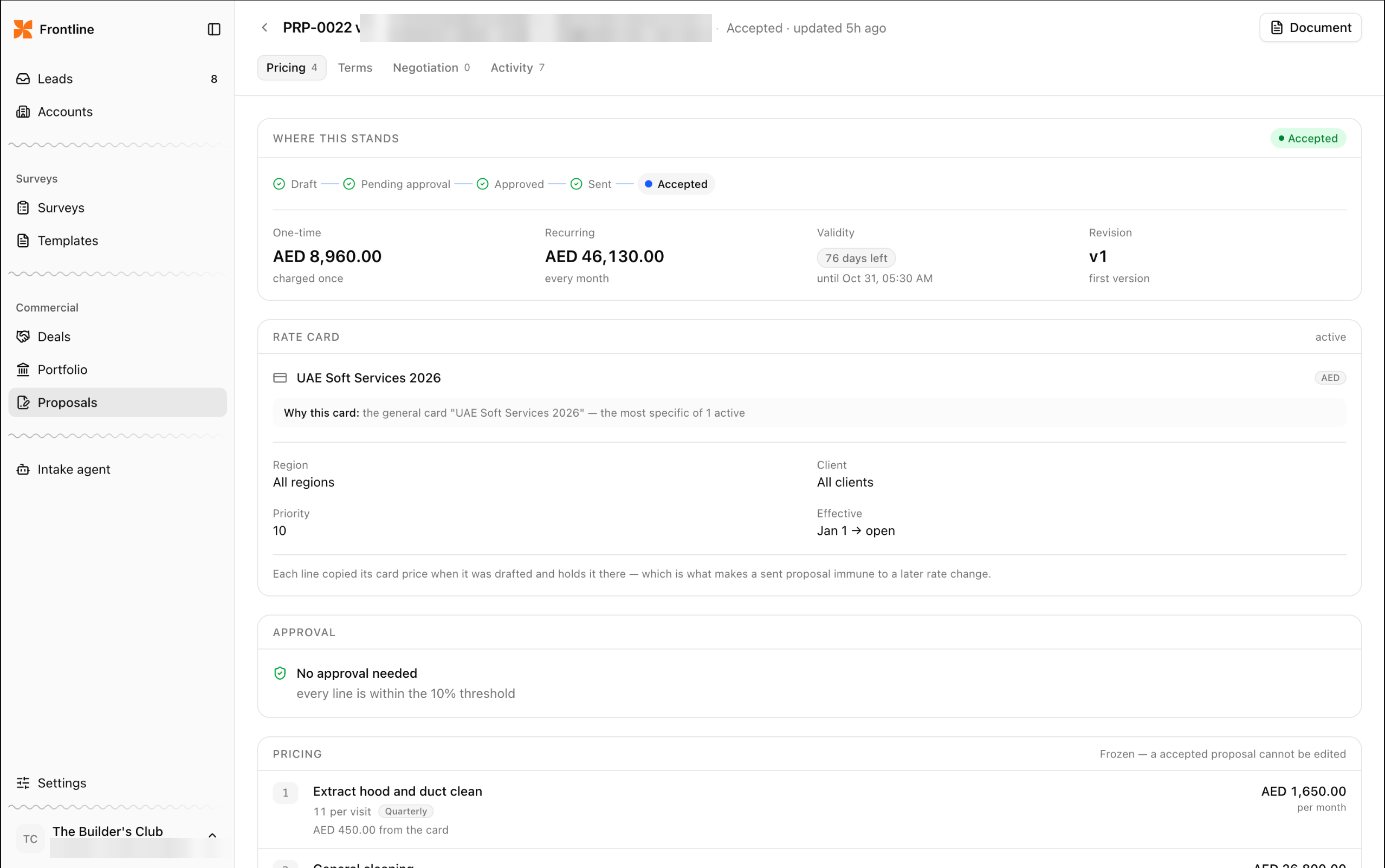
- Every price traces back to a question. Each survey answer is tagged to a rate-card line, so quantity times rate is the price, and the reason for the chosen rate card is on record.
- Revise with a diff. 8 paying customers had open tickets asking for one Revise button. Each revision shows exactly what changed.
How an FM bid is really priced
Area becomes an asset count, the asset count becomes a workforce, and the workforce becomes a price. Frontline structures that chain instead of leaving it in a spreadsheet.
The desk side, on the web
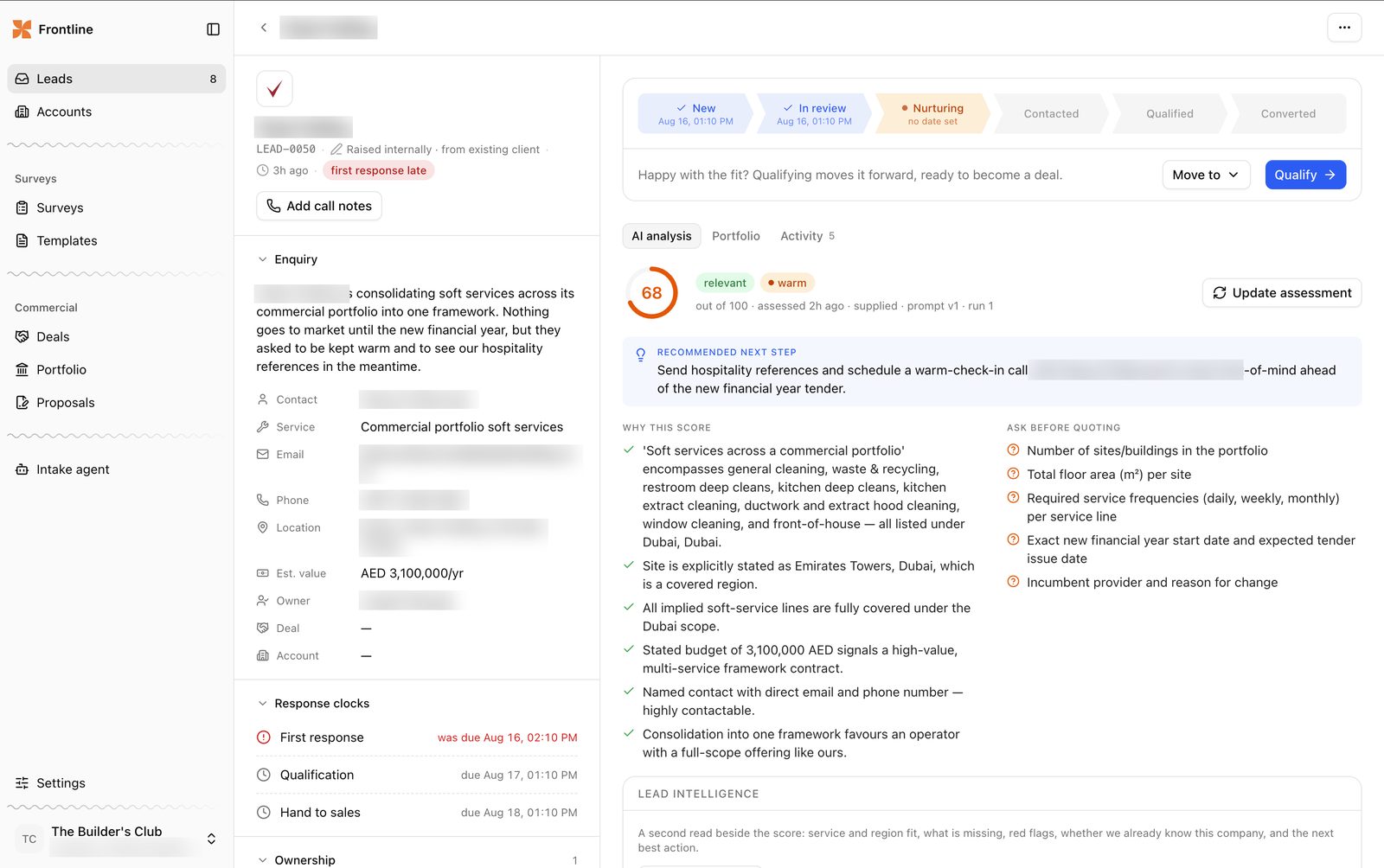
The surveyor walks on a phone. Sales and operations work on the web: every lead arrives scored with its reasons, and nothing is written to Facilio until the deal is won.
Decisions I'm proud of
- The site walk has no pre-filled grid. The surveyor taps "Add another room" and records each real room with its condition and access notes.
- A "no show" visit is its own outcome and never counts as surveyed.
- AI suggests. It never touches a quantity, a rate, a total or a status. Those are plain functions.
- We published a list of what we chose not to build, and every claim was checked against call transcripts. One popular number didn't survive the check, so we dropped it.
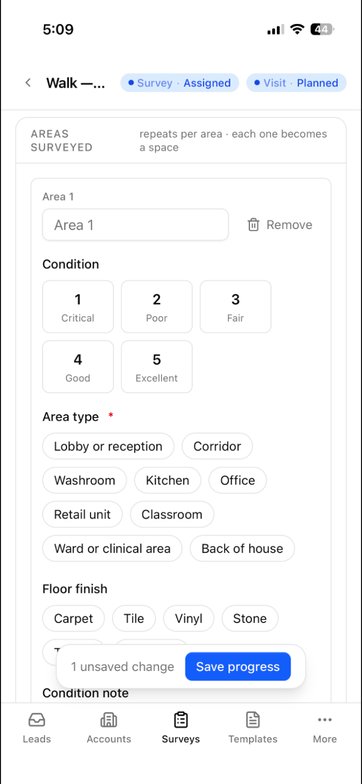
A condition score always shows with its word, so it can't be read backwards.