Every request came in by phone, email or WhatsApp and a helpdesk agent typed it into the system, about 3 minutes each. 88% of contacts were new jobs. After hours, the desk often came down to one person.
94% of requests are raised by the AI on its own: 1,629 in Q3 2026, about 540 a month, 70% by voice. Roughly 80 staff hours a quarter back on site work. People take the handoffs, not the typing.
Where it runs
At Berkeley Services in the UAE it runs as Al Najah: email, WhatsApp and calls around the clock, with urgent issues escalated straight away. At Q3 Services in the UK it runs as Bernard, taking requests by voice, email and WhatsApp.
I designed it as a set of agents, each doing one job a helpdesk operator does today: take the request, try a quick fix, route it, pick the technician, confirm the visit, chase the follow-ups, and ask the customer how it went.
- Customers
- Berkeley Services UAE, Q3 Services UK and CIT Group, Saudi Arabia
- Channels
- Voice, WhatsApp and email
- Volume
- About 540 requests a month, 70% by voice
- Languages
- English and Arabic
How the product came about
I didn't start with a customer. I started with the job.
- 1 · DiscoveryAbout fifty calls with FM teams across the Middle East, UK, US, Australia and India. I asked them to walk me through their day, not their software.
- 2 · One questionnaireSame questions to the most interested teams desk size, shifts, channels, new requests vs status checks, cost. New requests were 80 to 100% of contacts at most of them. One person covered nights. Every region used a different main channel.
- 3 · Jobs to be doneThree people, one job worth fixing The requester wants the problem logged and someone coming. The operator wants it in the system correctly, even at night. The FM manager wants fewer missed SLAs without more headcount. Intake was the highest volume, most repetitive and most measurable.
- 4 · PRDSeven agents, intake first One agent core, one flow per channel, emergencies always to a person. Customers wrote the guardrails: "reconfirm the details before raising the work order", "no wrong commitment on the appointment".
- 5 · First customerBerkeley Services UAE, on voice 88% of their contacts were new jobs. The first eval round sounded fine and the records were wrong: 10 of 14 requests had a blank or wrong site. I split record accuracy from conversation quality and fixed the record first.
- 6 · Same productConfigured per customer Voice first at Berkeley. Portal and email at Q3 Services, where half the contacts are status checks. WhatsApp first at CIT Group in Saudi Arabia.
Who does what on one call
- Code
- Hears the site's own place names (sent to the speech engine as hints), creates the work order through a tool with fixed fields, and limits clarifying questions to one before handing off.
- Model
- Understands the problem in the caller's own words, asks the follow-up, and picks the site, but only from the customer's real site list, so it can't invent a building.
- Person
- Emergencies, categories the customer names, anyone who asks for a person, quotes and approvals. No model decides a fire.
How the agents hand off
It isn't one big agent, and it isn't a free-for-all team. Each channel has its own small flow: an entry agent answers first, and it can hand off only along routes I drew. A code limit of two handoffs per turn stops agents passing the caller back and forth. At the limit, the agent has to answer. Loops are the fastest way to burn money, so the limit lives in code, not in the prompt.
Why intake came first at Berkeley
The case was in their own numbers: 88% of contacts were new jobs, 10% technician follow-ups and 1% status checks. Each new job took an agent about 3 minutes to type. That is roughly 80 staff hours a quarter now spent on site work instead.
What one night looks like
2:17 AM. A tenant calls about a water leak. The agent answers, takes the issue and location, and mid-call sends a WhatsApp asking for a photo. It reads the photo, marks it urgent plumbing, creates the request and sends the reference number back. About 90 seconds. Nobody had to wake up.
The release gate
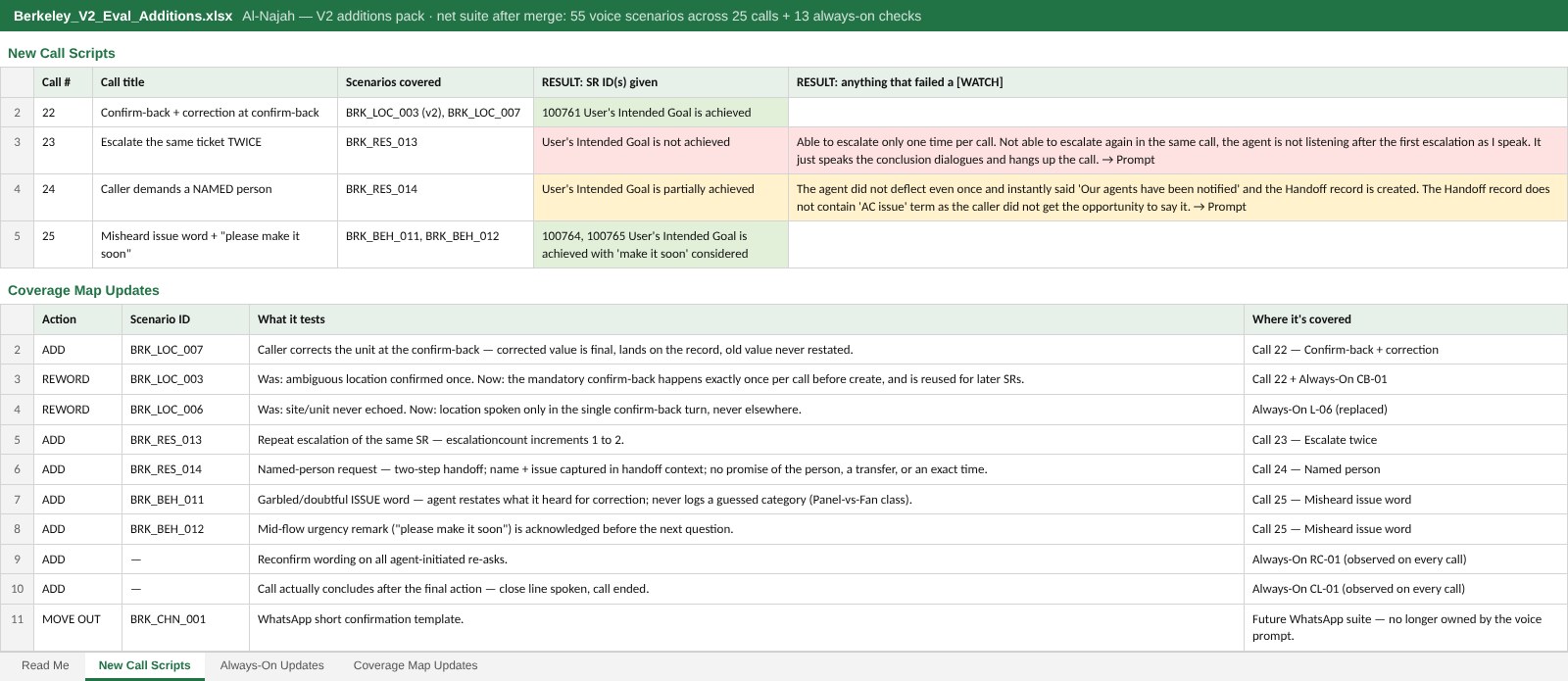
Berkeley's voice agent is tested against 55 scenarios across 25 scripted calls, plus 13 checks on every call. When the prompt changed, I didn't rerun the old suite and hope. I added only what the change touched, and logged failures as they came: calling to escalate the same ticket twice failed, and that became the next fix.
What broke after go-live
- Names. Speech-to-text heard "Al Furjan" as "Alpha John", so requests landed on the wrong site. We gave the speech engine all 144 Berkeley site names as words to listen for, and checked each result against the full site list.
- Noise. The agent asked "What is your name?", a child in the background said "Hey Mom", and "Mom" became the caller's name. Every detail is now read back to the caller before the request is raised.
- Voice manners. Cutting people off, not waiting, not following the script. Many nights of testing went into this, and some of it still shows up in production.
What I'd do differently
Start with a voice that sounds local. A Saudi accent is not a UAE accent, and you can't sound American in the UK. We learned it in production; Berkeley moved to a female voice that speaks both Arabic and English.
Calls I had to make
- Speed vs thinking time, per channel. A tenant on a phone call won't wait. An email agent can take longer and reason more.
- Where the human stays. Emergencies and categories the customer names go straight to a person. That path was designed in from day one.
- Prompt vs pipeline. If a rule needs memory the model doesn't have, like "stop replying to auto-replies", it lives in the pipeline, not the prompt.
- Pricing. We tried per seat and prepaid credits, dropped both, and landed on paying per action.
Learning from the market
Before designing setup, I walked through five AI support products end to end and noted how each handles onboarding, knowledge sources, human handoff, testing and analytics. That shaped a self-serve setup where a facility team answers a few plain questions (what you manage, what to do with requests you don't handle, what counts as an emergency, what every caller must give) and gets a working agent.
What counts as a failure
I keep a fixed list of what goes wrong in AI conversations: no reply, slow replies, made-up facts, repeating itself, missing frustration, a bad greeting or goodbye, a broken handoff, not collecting enough detail, wrong tone, interrupting, and the big one, not actually doing the job.
How I test before customers touch it
Misheard words get their own test: if the agent isn't sure what it heard ("panel" or "fan"), it says back what it heard so the caller can correct it, and never logs a guess. 50+ real scenarios per agent, scored against the actual records in the system, not the reply text. Every prompt change is versioned and re-tested, and old chat sessions are cleared for every contact before anyone tests again.