Facility managers opened every vendor invoice and checked it by hand against the work order. On 54 invoices already approved or paid, the PDF and the system amount differed by AUD 17,366 in total.
Two models read every invoice before anyone approves it. In five weeks of watch-only mode: 2,541 checked, 210 stopped at a hard check, the AI wrong on about 1%. Live, July to September 2026: 13,872 checked, AUD 1.26M of invoices held until the details were right, and reviewers overturned 3 of 12,131 AI results.
How it works
Payment Validator reads the PDF, compares it with the record and shows the result side by side. Hard failures are rejected automatically and the vendor is emailed. Clean invoices are marked safe to approve. The manager only looks at what needs a human.
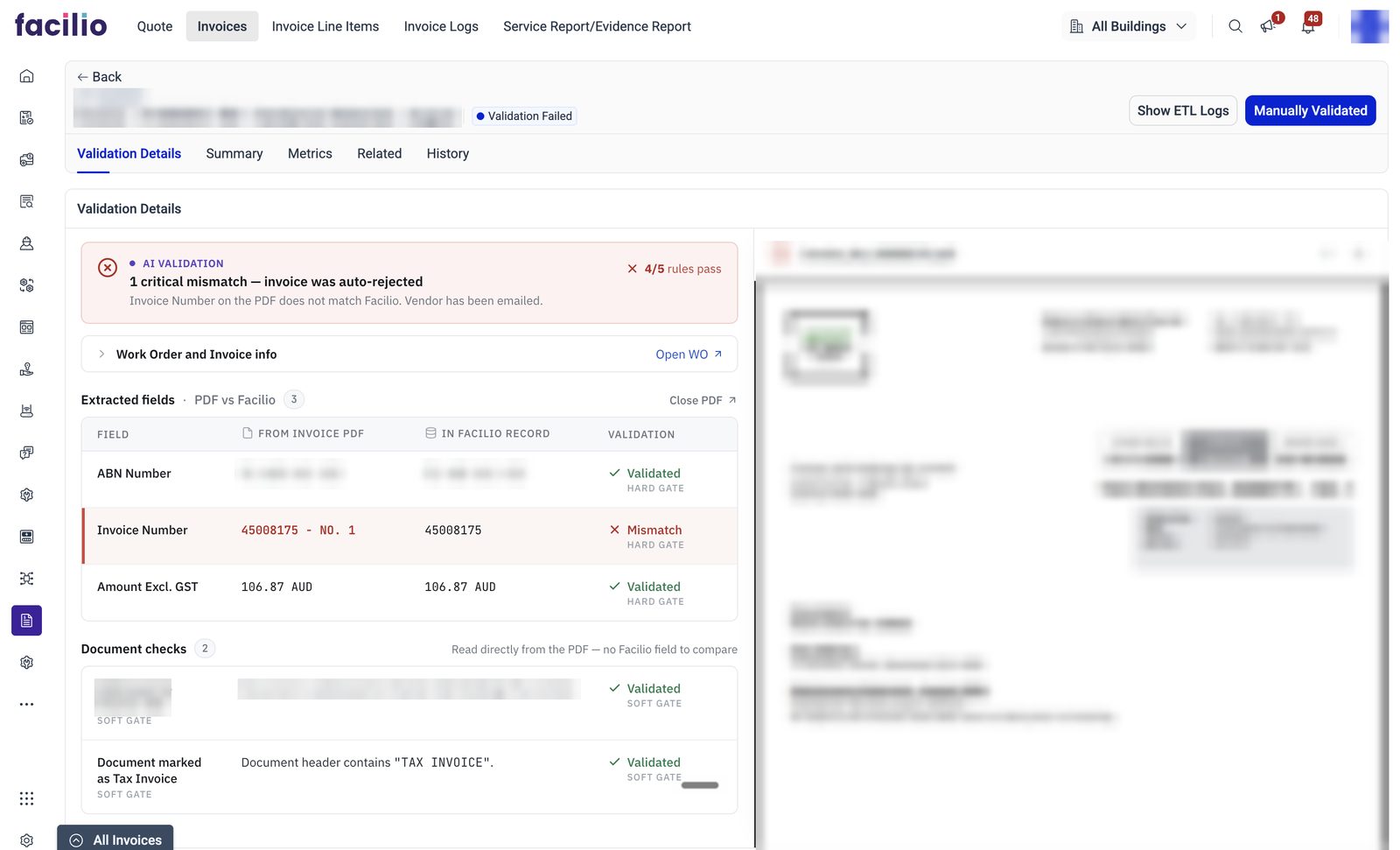
Two kinds of checks
Hard checks compare a field on the PDF with the same field in the system: business number, invoice number, amount before tax. A mismatch stops the invoice. Soft checks read the document itself, like who it's addressed to and whether it says "Tax Invoice". A soft failure is flagged for the manager to decide.
Two models must agree
One model reading a PDF can be confidently wrong. So two models read every invoice in parallel. If they agree, the values are checked against the record. If they disagree, a third model breaks the tie. If there is still no agreement, nothing is guessed: an internal record is raised and the team is notified. Every disagreement is logged by model, which tells us which model to trust for which kind of document. The design went through three versions on the whiteboard before it shipped.
How a value is trusted
Building for trust
Finance teams won't hand money decisions to a black box. So the reviewer always sees the PDF next to the result, every check names its rule, and the dashboard tracks people checking the AI: manual reviews, mistakes found, and AI errors by rule. Resubmitted invoices are tracked separately from first attempts.
Pricing
Charged per validated invoice, so cost follows the work the customer actually sends through.
What the pilot showed
For five weeks (20 Mar – 27 Apr 2026) the AI only watched. It checked 2,541 invoices and would have stopped 210 of them. When the team checked those 210 by hand, the AI was wrong on about 1%.
It also caught what people had missed. 54 invoices had already been approved or paid even though the amount on the PDF didn't match the system, a total gap of AUD 17,366. Those were human misses, and they are why the validator went live.
What I'd do differently
Plan for two models failing at once. We hadn't, and for one day validation quietly didn't run on about 40 to 50 invoices with nobody told. Now a failed run alerts engineering and product.